
Your leadership team meets. Everybody talks. Lots of nodding. Then you leave, and people interpret what you said in three completely different ways.
Your manager briefs her team on a new initiative. Everyone engages. Two weeks later, they’re working at cross-purposes because they understood the “why” so differently that the what fell apart.
Here’s what HR and L&D leaders tell us: “Our teams communicate regularly. But they still can’t trust each other, communicate effectively, or align.”
It’s not a communication frequency problem. It’s a communication language problem.
Why “More Communication” Doesn’t Work
We’ve spent years pushing more communication. Real-time chat. Async updates. Daily standups. Overcommunication became the default response to uncertainty.
But the problem isn’t that people aren’t hearing you. The problem is they’re interpreting what they hear through their own behavioral lens.
Think about your last team meeting. The Direct person heard an urgent call to action. The Influencer heard an opportunity to energize the team. The Steady person heard potential change and got nervous. The Analytical person heard ambiguity and started noting details that need clarifying.
Same message. Four different interpretations. Four different levels of trust in the direction.
The Real Cost of the Gap
A culture trust gap kills performance. When people don’t trust that others understand them, engagement drops. Psychological safety evaporates. People stop speaking up.
But here’s what most leaders miss: the trust gap doesn’t happen because people are bad communicators. It happens because people are speaking in different behavioral dialects and nobody’s translating.
Most organizations respond by adding MORE structure, MORE process, MORE communication. They build project management systems and governance frameworks. These help a little. But they treat the symptom, not the disease.
The disease is this: Your people don’t have a shared language for how different types of people think, prioritize, and work.
Enter: The DiSC® Common Language
DiSC describes four behavioral styles based on how people approach tasks and relationships:
D (Dominance): Direct, results-focused, decisive.
i (Influence): Energetic, collaborative, expressive.
S (Steadiness): Supportive, patient, loyal.
C (Conscientiousness): Analytical, detail-oriented, quality-driven.
None of these is “better.” But they’re different. And when people understand the difference, communication shifts.
That technical person asking clarifying questions isn’t being difficult—they’re being conscientious. The colleague who wants to jump into action isn’t being reckless—they’re being direct. When your team has a shared DiSC language, they stop personalizing behavioral differences and start normalizing them. Trust follows.
How Everything DiSC® on Catalyst Makes This Real
Here’s where most DiSC implementations fail: People take the assessment, have a “wow” conversation or training session, then forget about it.
Not with Catalyst. Everything DiSC on Catalyst is a platform that lives in your daily workflow. After your team completes the assessment, they get access to:
Your DiSC Style: A personalized narrative showing how your style shows up under pressure, in conflict, and under change.
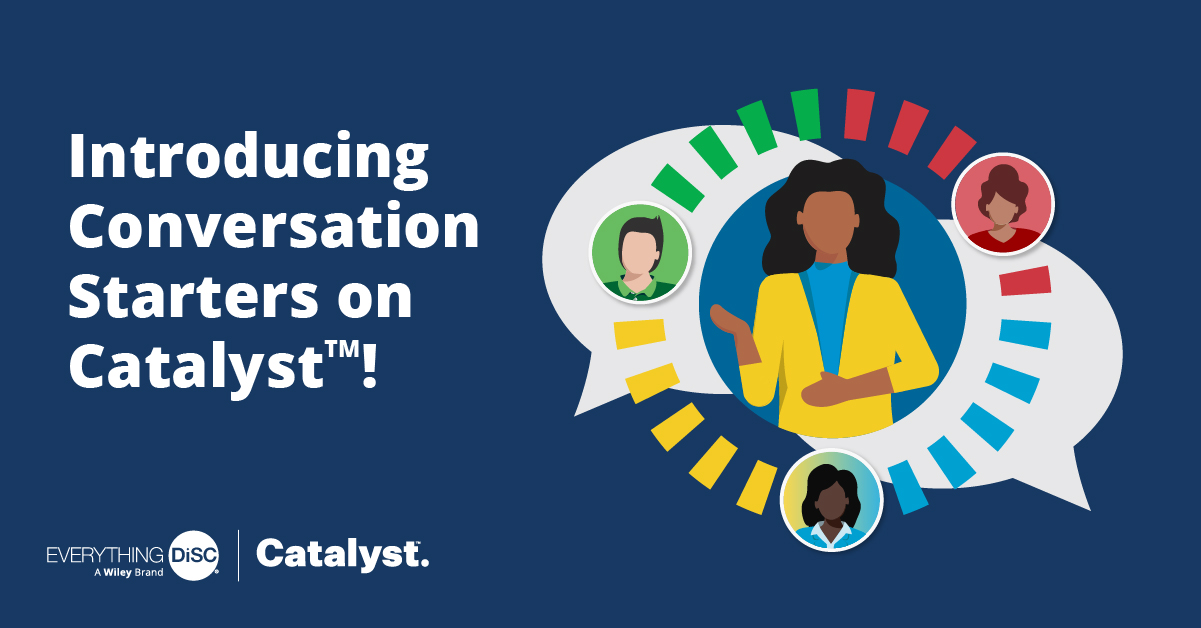
Your Colleagues: Look up colleagues and see how to work more effectively with them. Before a 1:1, pull up your manager’s profile. Before a kickoff, map everyone’s styles and anticipate friction.
Your Groups: See your team’s collective profile, strengths, and where the style mix might create friction. Design how you communicate so everyone feels heard.
Ongoing Modules: Interactive content on workplace priorities, managing conflict, building relationships, and adapting to other styles.
The result? 74% of learners return to Catalyst repeatedly. It’s not a one-time event—it’s an everyday tool.
What Changes When Your Culture Has a DiSC Foundation
Better Onboarding: New hires know their style and their team’s styles on day one. They stop guessing how to work with their manager.
Fewer Misunderstandings: When conflict happens, people have a framework. “She’s direct-wired to make fast decisions” is a very different conversation than “She doesn’t trust my judgment.”
Stronger Cross-Functional Collaboration: You can design decisions so both voices—the data-driven person and the speed-focused person—get heard. Collaboration becomes partnership, not negotiation.
Real Change Management: When change happens, you can communicate it in ways that land for different people. You’re not just announcing change—you’re building confidence in it.
Why This Time Is Different
You might be thinking: “We’ve done personality assessments before. Nothing really changed.” Fair point.
DiSC Catalyst is different for three reasons:
It’s built for organizations, not individuals. Your whole team takes it together, so the shared language is immediate.
It lives in the work. People pull up Catalyst before meetings, before decisions, before conflicts. It’s an everyday tool, not an annual training event.
It drives measurable outcomes. Organizations that adopt behavior-based approaches see increased team performance, better talent identification, reduced turnover, and stronger cultures.
Coaching Thoughts
Your teams talk. They just don’t align. And that gap costs you in engagement, retention, and performance. But it’s fixable. It’s not about changing people. It’s about helping them understand each other differently.
The question isn’t whether your teams will communicate differently when they have DiSC as a common language. The question is: What will change when they finally understand each other?
Start there.
Lean more about Everything DiSC on Catalyst.